Ethical Boundaries of AI Users
The Philosophical Approach of Utilitarianism, Deontology, and Nicomachean Ethics in the Context of Education
DOI:
https://doi.org/10.55935/thilo.v7i2.328Keywords:
happiness, pleasure, appregate, consequentialism, maxim, categorical imperative, virtue activity, rationality, experience machine, authentic experienceAbstract
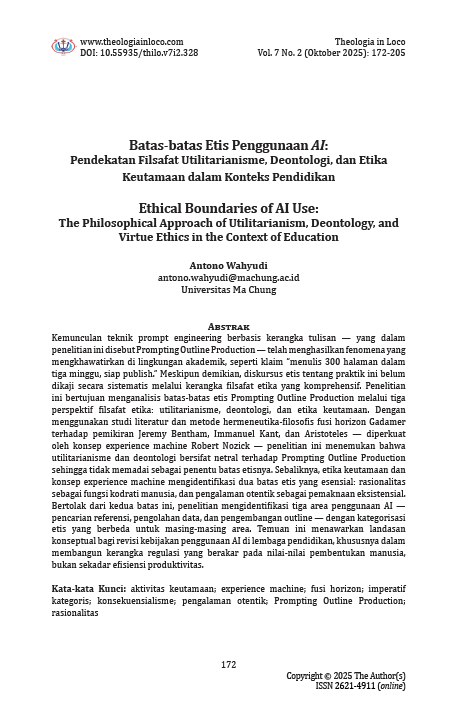
The use of Artificial Intelligence (AI) through outline-based prompt engineering, referred The emergence of outline-based prompt engineering — referred to in this study as Prompting Outline Production — has produced troubling phenomena in academic environments, such as claims of “writing 300 pages in three weeks, ready to publish.” Despite growing concern, the ethical dimensions of this practice have not yet been examined systematically through a comprehensive framework of ethical philosophy. This study aims to analyze the ethical limits of Prompting Outline Production through three philosophical perspectives: utilitarianism, deontology, and virtue ethics. Drawing on a literature review and Gadamer’s philosophical-hermeneutical method of horizon fusion applied to the thought of Jeremy Bentham, Immanuel Kant, and Aristotle — and reinforced by Robert Nozick’s concept of the experience machine — the study finds that utilitarianism and deontology yield neutral verdicts on Prompting Outline Production and are therefore insufficient as determinants of its ethical limits. Virtue ethics and the experience machine concept, by contrast, identify two essential ethical boundaries: rationality as the natural function of the human person, and authentic experience as existential meaning-making. From these two boundaries, the study identifies three distinct areas of AI use — reference searching, data processing, and outline development — each carrying a different ethical categorization. These findings offer a conceptual foundation for revising AI use policies in educational institutions, particularly in building a regulatory framework rooted in the values of human formation rather than mere productive efficiency.
Downloads
References
Aristotle. Nicomachean Ethics. Translated by Roger Crisp. Cambridge Texts in the History of Philosophy. Cambridge: Cambridge University Press, 2004.
Bentham, Jeremy. An Introduction to the Principles of Morals and Legislation. Kitchener: Batoche Books, 2000.
Copleston, Frederick Charles. History of Philosophy Volume 6: The Enlightenment: Voltaire to Kant. London: Continuum, 2011.
Hirji, Sukaina. “Acting Virtuously as an End in Aristotle’s Nicomachean Ethics.” British Journal for the History of Philosophy 26, no. 6 (November 2018): 1006–26. https://doi.org/10.1080/09608788.2018.1454296.
Huda, Achmad Nuril, Agung Winarno, and Khoirul Yahya. “Transhumanism Ethics: A Critical Analysis of AI Technology Development and Its Implications for Humanity.” Journal of Islamic Thought and Philosophy 3, no. 2 (December 2024): 273–92. https://doi.org/10.15642/jitp.2024.3.2.273-292.
Ibrahim, Teguh, and Ani Hendriani. “Kajian Reflektif Etika Guru Dalam Perspektif Ki Hajar Dewantara Berbaluk Filsafat Moral Utilitarianisme.” Naturalistic: Jurnal Kajian Penelitian Pendidikan Dan Pembelajaran 1, no. 2 (April 2017): 135–45. https://doi.org/10.35568/naturalistic.v1i2.12.
Irnawati, Yuni Fatmawati, I. Ketut Mahardhika, and Suratno Suratno. “The Ethics of Using Artificial Intelligence (AI) in Learning in a Philosophical Perspective.” International Journal of Education, Information Technology, and Others 7, no. 4 (December 2024): 319–30.
Ismail, Nur Syakiran Akmal, and Abderrahmane Benlahcene. “A Narrative Review Of Ethics Theories: Teleological & Deontological Ethics.” IOSR Journal Of Humanities And Social Science 23, no. 7 (2018). https://doi.org/10.9790/0837-2307063138.
Kant, Immanuel. The Moral Law: Groundwork of the Metaphysics of Morals. Translated by Herbert James Paton. Hoboken: Taylor and Francis, 1992.
Küçükuysal, Bahadır, and Erhan Beyhan. “Virtue Ethics in Aristotle’s Nicomachean Ethics.” Journal of Human Sciences 8, no. 2 (July 2011): 43–51.
Kusumawardani, Sri Suning, Dewi Wulandari, Paulina Pannen, F. Astha Ekadiyanto, I. Made Wiryana, Ayu Purwarianti, and Syukron Abu Ishaq Alfarozi. Panduan Penggunaan Generative Artificial Intelligence (GenAI) Pada Pembelajaran Di Perguruan Tinggi. Jakarta: Direktorat Pembelajarandan Kemahasiswaan, Direktorat Jenderal Pendidikan Tinggi, Riset, dan Teknologi, Kemendikbudristek, 2024.
Liu, Gengmeng. “Artificial Intelligence and Ethics: Moral Challenges from a Philosophical Perspective.” In Proceedings of the 2024 6th International Conference on Literature, Art and Human Development, vol. 885, edited by Sertac Kaki, Bootheina Majoul, Mohd Farid Mohd Sharif, and Sharifah Faizah Syed Mohammed, 408–13. Advances in Social Science, Education and Humanities Research. Paris: Atlantis Press SARL, 2024. https://doi. org/10.2991/978-2-38476-319-1_47.
Londok, Halomoan. “Kontribusi Hermeneutik Hans-Georg Gadamer Bagi Dialog Antaragama Di Indonesia.” Sanjiwani: Jurnal Filsafat 13, no. 2 (September 2022): 177–87. https://doi.org/10.25078/sanjiwani.v13i2.1029.
Nozick, Robert. Anarchy, State, and Utopia. Philadelphia, PA: Basic Books, 2013.
O’Neill, Onora. Acting on Principle: An Essay on Kantian Ethics. Cambridge: Cambridge University Press, 2013.
Pasopati, Rommel Utungga, Chili Podang Bethari, Dewi Syifanaya Firdausy Nurdin, Myrilla Shafa Camila, and Sanjaya Ahmad Hidayat. “Ethical Consequentialism in Values and Principles of UNESCO’s Recommendation on the Ethics of Artificial Intelligence.” Proceeding International Conference on Religion, Science and Education 3 (March 2024): 567–79.
Pratiwi, Endang, Theo Negoro, and Hassanain Haykal. “Teori Utilitarianisme Jeremy Bentham: Tujuan Hukum Atau Metode Pengujian Produk Hukum?” Jurnal Konstitusi 19, no. 2 (June 2022): 268. https://doi.org/10.31078/jk1922.
Ramli, Mohammad. “Mengeksplorasi Tantangan Etika Dalam Penggunaan Chat GPT Sebagai Alat Bantu Penulisan Ilmiah: Pendekatan Terhadap Integritas Akademik.” TA’DIBAN: Journal of Islamic Education 4, no. 1 (December 2023): 1–10. https://doi.org/10.61456/tjie.v4i1.129.
Roff, Heather M. “Expected Utilitarianism.” Version 1. Preprint, arXiv, 2020. https:// doi.org/10.48550/ARXIV.2008.07321.
Szmyd, Katarzyna, and Ewelina Mitera. “The Impact of Artificial Intelligence on the Development of Critical Thinking Skills in Students.” European Research Studies Journal XXVII, no. 2 (April 2024): 1022–39. https://doi.org/10.35808/ersj/3876.
Ulgen, Ozlem. “Kantian Ethics in the Age of Artificial Intelligence and Robotics.” Questions of International Law (QIL), Zoom-in 43, 2017. https://www.qil-qdi. org/kantian-ethics-age-artificial-intelligence-robotics/.
Additional Files
Published
Issue
Section
License
Copyright (c) 2026 Antono Wahyudi

This work is licensed under a Creative Commons Attribution-NonCommercial-ShareAlike 4.0 International License.
The author retains copyright and also agrees to grant Theologia in Loco the right of first publication with the work simultaneously licensed under CC Attribution-NonCommercial-ShareAlike 4.0.