The Ethics of War in Judaism, Islam and International Humanitarian Law in Justifying the 2026 Iran-Israel-United States War
DOI:
https://doi.org/10.55935/thilo.v8i1.369Keywords:
ethics of war, milhemet mitzvah, jihad, international humanitarian law, 2026 Iran-Israel-US conflict, jus ad bellum, Jus in belloAbstract
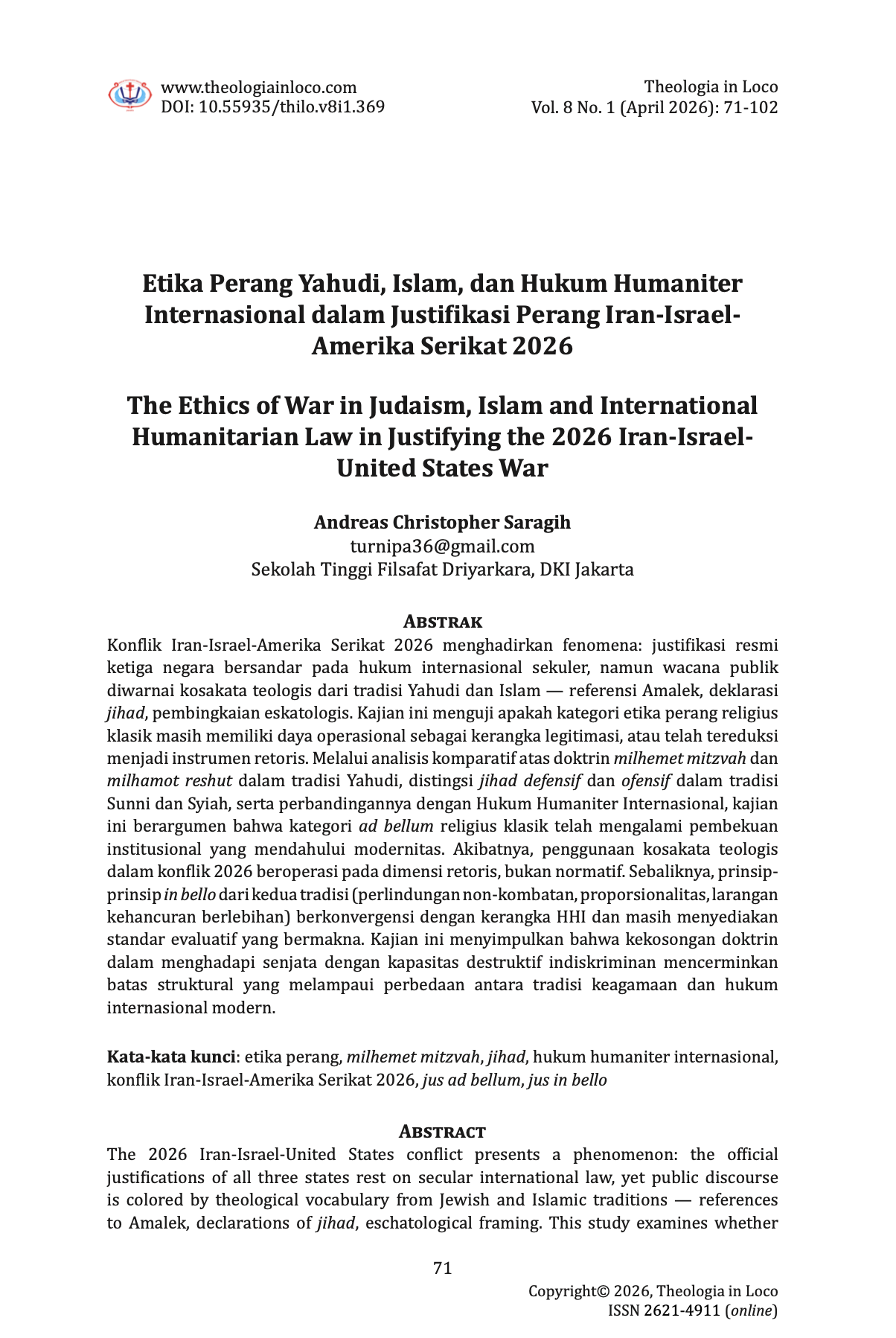
The 2026 Iran-Israel-United States conflict presents a phenomenon: the official justifications of all three states rest on secular international law, yet public discourse is colored by theological vocabulary from Jewish and Islamic traditions — references to Amalek, declarations of jihad, eschatological framing. This study examines whether classical religious war ethics categories still retain operational force as frameworks of legitimation, or have been reduced to rhetorical instruments. Through a comparative analysis of the doctrines of milhemet mitzvah and milhamot reshut in the Jewish tradition, the distinction between defensive and offensive jihad in Sunni and Shia traditions, and their comparison with International Humanitarian Law, this study argues that classical religious ad bellum categories have undergone an institutional freezing that predates modernity. Consequently, the use of theological vocabulary in the 2026 conflict operates on a rhetorical rather than normative dimension. Conversely, the in bello principles of both traditions (protection of non-combatants, proportionality, prohibition of excessive destruction) converge with the IHL framework and still provide meaningful evaluative standards. This study concludes that the doctrinal vacuum in confronting weapons with indiscriminate destructive capacity reflects a structural limitation that transcends the divide between religious traditions and modern international law.
Downloads
References
Al-Dawoody, Ahmed. Hukum Perang Islam. Diterjemahkan oleh Ayu Novika Hidayati. Jakarta: Kepustakaan Gramedia Populer dan ICRC Indonesia, 2019.
Arjomand, Said Amir. The Shadow of God and the Hidden Imam: Religion, Political Order, and Societal Change in Shi’ite Iran from the Beginning to 1890. Chicago: University of Chicago Press, 1984.
Dinstein, Yoram. War, Aggression and Self-Defence. 6 ed. Cambridge: Cambridge University Press, 2017.
Gray, Christine. International Law and the Use of Force. 4 ed. Oxford: Oxford University Press, 2018.
Hashmi, Sohail H. “Interpreting the Islamic Ethics of War and Peace.” Dalam The Ethics of War and Peace: Religious and Secular Perspectives, disunting oleh Terry Nardin. Princeton: Princeton University Press, 1996.
Hummel, Daniel G. Covenant Brothers: Evangelicals, Jews, and U.S.-Israeli Relations. Philadelphia: University of Pennsylvania Press, 2019.
Iruobe, Victor, dan Ikpenmosa Uhumuavbi. “Retaliatory Sovereignty: Israel, Iran, and the Juridification of Existential Threat.” Journal on the Use of Force and International Law 13, no. 1 (2026): 112–39.
Kelsay, John. “Sunni Islam and the Regulation of War.” Dalam The Prism of Just War: Asian and Western Perspectives on the Legitimate Use of Military Force, disunting oleh Howard M. Hensel. Surrey: Ashgate Publishing, 2010.
Kirazli, Harris Sadik. “From Nonviolence to Reconciliation: The Prophetic Political Ethics of War and Peace.” Religions 17, no. 4 (2026): 449.
Larsen, Jonathan. “US Troops Were Told Iran War Is for ‘Armageddon,’ Return of Jesus.” Asia Times, 4 Maret 2026. https://asiatimes.com/2026/03/us-troops-were-told-iran-war-is-for-armageddon-return-of-jesus/.
Legality of the Threat or Use of Nuclear Weapons, ICJ Reports 1996 ___ (International Court of Justice 1996).
Melzer, Nils. Targeted Killing in International Law. Oxford: Oxford University Press, 2008.
Morkevicius, Valerie. “Shi’i Perspectives on War.” Dalam The Prism of Just War: Asian and Western Perspectives on the Legitimate Use of Military Force, disunting oleh Howard M. Hensel. Surrey: Ashgate Publishing, 2010.
Nakissa, Aria. “Comparing Moralities in the Abrahamic and Indic Religions Using Cognitive Science: Kindness, Peace, and Love versus Justice, Violence, and Hate.” Religions 14, no. 2 (2023): 203. https://doi.org/10.3390/rel14020203.
Protocol Additional to the Geneva Conventions of 12 August 1949, and Relating to the Protection of Victims of International Armed Conflicts (Protocol I) (1977). https://ihl-databases.icrc.org/assets/treaties/470-AP-I-EN.pdf.
Ravitzky, Aviezer. “Prohibited War in the Jewish Tradition.” Dalam The Ethics of War and Peace: Religious and Secular Perspectives, disunting oleh Terry Nardin. Princeton: Princeton University Press, 1996.
Ricoeur, Paul. Lectures on Ideology and Utopia. Disunting oleh George H. Taylor. New York: Columbia University Press, 1986.
Schmitt, Michael. “A Primer on Just War Theory and the Iran War.” Just Security, 20 April 2026.
Schwartz, Dov. Religious Zionism: History and Ideology. Brighton: Academic Studies Press, 2009.
Shamim, Sarah. “Why Are the US and Israel Framing the Ongoing Conflict as a Religious War?” Al Jazeera, 4 Maret 2026. https://www.aljazeera.com/news/2026/3/4/why-are-the-us-and-israel-framing-the-ongoing-conflict-as-a-religious-war.
Solomon, Norman. “The Ethics of War: Judaism.” Dalam The Ethics of War: Shared Problems in Different Traditions, disunting oleh Richard Sorabji dan David Rodin. London: Routledge, 2016.
Spitzer, Jeffrey. “The Noahide Laws: Seven commandments which, according to Jewish tradition, are incumbent upon all of humankind.” My Jewish Learning, t.t. https://www.myjewishlearning.com/article/the-noahide-laws/.
Walzer, Michael. “War and Peace in Jewish Tradition.” Dalam The Ethics of War and Peace Religious and Secular Perspectives, disunting oleh Terry Nardin. Princeton: Princeton University Press, 1996.
“Iran Adviser Tells Iraq Protests Are a ’Plot Against the Whole Region.” Iran International, 20 Januari 2026. https://www.iranintl.com/en/202601208189.
“Iran General Warns Trump ‘We Will Set Their World on Fire’ if Khamenei Attacked.” Iran International, 20 Januari 2026. https://www.iranintl.com/en/202601200275.
“Iran War 2026.” Encyclopedia Britannica, 14 Juni 2026. https://www.britannica.com/event/2026-Iran-war.
Additional Files
Published
Issue
Section
License
Copyright (c) 2026 Andreas Christopher Saragih

This work is licensed under a Creative Commons Attribution-NonCommercial-ShareAlike 4.0 International License.
The author retains copyright and also agrees to grant Theologia in Loco the right of first publication with the work simultaneously licensed under CC Attribution-NonCommercial-ShareAlike 4.0.