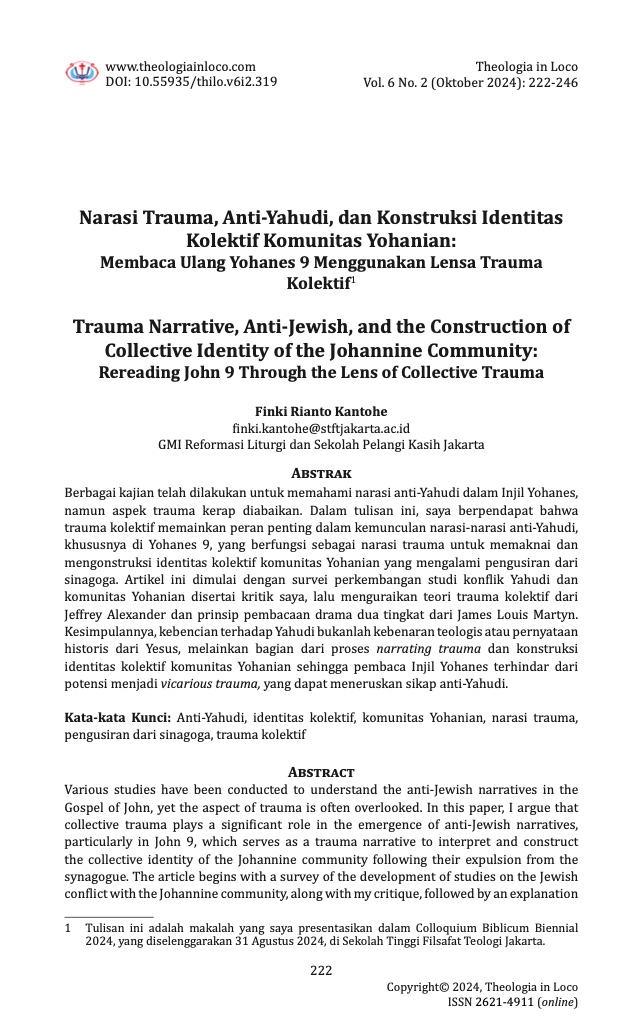
Narasi Trauma, Anti-Yahudi, dan Konstruksi Identitas Kolektif Komunitas Yohanian
Membaca Ulang Yohanes 9 Menggunakan Lensa Trauma Kolektif
DOI:
https://doi.org/10.55935/thilo.v6i2.319Kata Kunci:
Anti Yahudi, identitas kolektif, komunitas Yohanian, narasi trauma, pengusiran dari sinagoga, trauma kolektifAbstrak
Yohanes, namun aspek trauma kerap diabaikan. Dalam tulisan ini, saya berpendapat bahwa trauma kolektif memainkan peran penting dalam kemunculan narasi-narasi anti-Yahudi, khususnya di Yohanes 9, yang berfungsi sebagai narasi trauma untuk memaknai dan mengonstruksi identitas kolektif komunitas Yohanian yang mengalami pengusiran dari sinagoga. Artikel ini dimulai dengan survei perkembangan studi konflik Yahudi dan komunitas Yohanian disertai kritik saya, lalu menguraikan teori trauma kolektif dari Jeffrey Alexander dan prinsip pembacaan drama dua tingkat dari James Louis Martyn. Kesimpulannya, kebencian terhadap Yahudi bukanlah kebenaran teologis atau pernyataan historis dari Yesus, melainkan bagian dari proses narrating traumadan konstruksi identitas kolektif komunitas Yohanian sehingga pembaca Injil Yohanes terhindar dari potensi menjadi vicarious trauma, yang dapat meneruskan sikap anti-Yahudi.Unduhan
Referensi
Alexander, Jeffrey C. “Toward a Theory of Cultural Trauma.” In Cultural Trauma and Collective Identity. Berkeley, Calif: University of California Press, 2004.
———. Trauma: A Social Theory. Cambridge, UK ; Malden, MA: Polity, 2012.
Alexander, Jeffrey C., Ron Eyerman, Benhard Giesen, Neil J Smelser, and Piotr Sztompka, eds. Cultural Trauma and Collective Identity. Berkeley, Calif: University of California Press, 2004.
Allwood, Maureen, Bita Ghafoori, Salgado Carolina, Ortal Slobodin, Johanna Kreither, Lynn Waelde, and P. Larrando. “Identity-Based Hate and Violence as Trauma: Current Research, Clinical Implications, and Advocacy in a Globally Connected World.” Journal of Traumatic Stress, December 1, 2021. https://doi.org/10.1002/jts.22748.
Ashton, John. The Gospel of John and Christian Origins. Fortress Press, 2014.
Bauckham, Richard. Gospel of Glory: Major Themes in Johannine Theology. Grand Rapids, Michigan: Baker Academic, 2015.
Bauer, Walter. A Greek-English Lexicon of the New Testament and Other Early Christian Literature, 3rd Edition. Edited by Frederick William Danker. 3rd edition. Chicago: University of Chicago Press, 2000.
Bernier, Jonathan. Aposynagōgos and the Historical Jesus in John: Rethinking the Historicity of the Johannine Expulsion Passages. Biblical Interpretation Series, VOLUME 122. Boston: Brill, 2013.
Boase, Elizabeth. “Fragmented Voices: Collective Identity and Traumatization in Lamentations.” In Bible through the Lens of Trauma, edited by Elizabeth Boase and Christopher G. Frechette, First Edition. Atlanta: SBL Press, 2016.
Boase, Elizabeth, and Christopher G. Frechette. “Defining ‘Trauma’ As a Useful Lens for Biblical Interpretation.” In Bible through the Lens of Trauma, edited by Elizabeth Boase and Christopher G. Frechette, First Edition. Atlanta: SBL Press, 2016.
Brown, Raymond E. “‘Other Sheep Not of This Fold’: The Johannine Perspective on Christian Diversity in the Late First Century.” Journal of Biblical Literature 97, no. 1 (March 1978): 5. https://doi.org/10.2307/3265832.
Bultmann, Rudolf. The History of the Synoptic Tradition. Translated by John Marsh. Revised edition. Hendrickson Pub, 1994.
Carter, Warren. John and Empire: Initial Explorations. New York: T & T Clark, 2008.
Cook, Guillermo. “Seeing, Judging and Acting: Evangelism in Jesus’ Way.” International Review of Mission 87, no. 346 (1998): 388–96.
De Boer, Martinus C. “Expulsion from the Synagogue: J. L. Martyn’s History and Theology in the Fourth Gospel Revisited.” New Testament Studies 66, no. 3 (July 2020): 367–91. https://doi.org/10.1017/S0028688519000535.
Doole, J. Andrew. “To Be ‘An Out-of-the-Synagoguer.’” Journal for the Study of the New Testament 43, no. 3 (March 2021): 389–410. https://doi.org/10.1177/0142064X20973905.
Ehrman, Bart D. The New Testament: A Historical Introduction to the Early Christian Writings. 2nd ed. New York: Oxford University Press, 2000.
Evans, Craig A. From Jesus to the Church: The First Christian Generation. Westminster John Knox Press, 2014.
Eyerman, Ron. Memory, Trauma, and Identity. 1st ed. 2019 edition. New York, NY: Palgrave Macmillan, 2019.
———. Memory, Trauma, and Identity. 1st ed. 2019 edition. New York, NY: Palgrave Macmillan, 2019.
Hägerland, Tobias. “John’s Gospel: A Two-Level Drama?” Journal for the Study of the New Testament 25, no. 3 (March 2003): 309–22. https://doi.org/10.1177/0142064X0302500304.
Hakola, Raimo. Reconsidering Johannine Christianity: A Social Identity Approach. BibleWorld. New York: Routledge, Taylor & Francis Group, 2015.
Hirschberger, Gilad. “Collective Trauma and the Social Construction of Meaning.” Frontiers in Psychology 9 (August 10, 2018): 1441. https://doi.org/10.3389/fpsyg.2018.01441.
Horsley, Richard A. Jesus and the Politics of Roman Palestine. Columbia (S.C.): University of South Carolina Press, 2014.
Kantohe, Finki Rianto. “My Father and Your Father (Jn. 20:17): Johannine Christians as the New Israel and the Anti-Judaism Community.” The American Journal of Biblical Theology, 37, 22 (2021): 1–18.
———. “Orang-Orang Farisi Dan Narsisisme Beragama: Tinjauan Mengenai Potret Orang-Orang Farisi Dalam Yohanes 9.” Jurnal Abdiel: Khazanah Pemikiran Teologi, Pendidikan Agama Kristen Dan Musik Gereja 4, no. 2 (October 27, 2020): 180–98. https://doi.org/10.37368/ja.v4i2.147.
Kantohe, Finki Rianto, and Samuel Benjamin Hakh. “Yesus Sang Mediator Yang Merengkuh Umat Termarginalisasi: Sebuah Analisis Sosio-Historis Terhadap Yohanes 9.” GEMA TEOLOGIKA: Jurnal Teologi Kontekstual Dan Filsafat Keilahian 5, no. 2 (October 27, 2020): 207–22. https://doi.org/10.21460/gema.2020.52.595.
Keener, Craig S. The Gospel of John. Softcover ed. Edition. Vol. 2. Grand Rapids, MI: Baker Academic, 2010.
Klink III, Edward W. “The Overrealized Expulsion in the Gospel of John.” In Aspects of Historicity in the Fourth Gospel, edited by Paul N Anderson, Felix Just, and Tom Thatcher, 2:175–84. John, Jesus, and History. Atlanta, GA: Society of Biblical Literature, 2009.
Kloppenborg, John S. “Disaffiliation in Associations and the Ἀποσυναγωγός of John.” HTS Teologiese Studies / Theological Studies 67, no. 1 (June 6, 2011): 16 pages. https://doi.org/10.4102/hts.v67i1.962.
Martyn, J. Louis. History and Theology in the Fourth Gospel. 3 edition. Louisville, Ky: Westminster John Knox Press, 2003.
Muderhwa, B. Vincent. “The Blind Man of John 9 as a Paradigmatic Figure of the Disciple in the Fourth Gospel.” HTS Teologiese Studies / Theological Studies 68, no. 1 (January 11, 2012): 10 pages. https://doi.org/10.4102/hts.v68i1.1008.
Pruszinski, Jolyon G. R. “Trauma & TYPOI: The Fourth Gospel as Warning Not Example.” Religions 14, no. 1 (December 23, 2022): 27. https://doi.org/10.3390/rel14010027.
Reinhartz, Adele. “Incarnation and Covenant: The Fourth Gospel through the Lens of Trauma Theory.” Interpretation: A Journal of Bible and Theology 69, no. 1 (January 2015): 35–48. https://doi.org/10.1177/0020964314552628.
Ridderbos, Herman N. The Gospel According to John: A Theological Commentary. Translated by John Vriend. Grand Rapids, Mich.: Eerdmans, 1997.
Schnackenburg, Rudolf. The Gospel According to St. John. Vol. 2. London, New York: Burns & Oates; Herder & Herder, 1968.
St Cyril of Alexandria. Glaphyra on the Pentateuch: Genesis. Translated by Nicholas P. Lunn. Washington, D.C: Catholic Univ of Amer Pr, 2019.
Thompson, Marianne Meye. John: A Commentary. Louisville, Kentucky: Westminster John Knox Press, 2015.
File Tambahan
Diterbitkan
Terbitan
Bagian
Lisensi
Hak Cipta (c) 2024 Finki Rianto Kantohe

Artikel ini berlisensiCreative Commons Attribution-NonCommercial-ShareAlike 4.0 International License.
Penulis memiliki hak untuk karyanya dan juga kepada jurnal Theologia in Loco hak publikasi dan distribusi pertama dalam edisi elektronik dan cetak secara bersamaan di bawah CC Attribution-NonCommercial-ShareAlike 4.0.